

Our Northumbrian Saints
Seeming remote to historians and archaeologists, our saints are constantly at our sides. We are in their prayers and they in ours. This is a mystical relationship that grows out of the Eucharistic fellowship, which is not so much a theological concept as an experienced reality. Here is a selection of icons of some of the best known. Mounted reproductions of these are available from the Community.
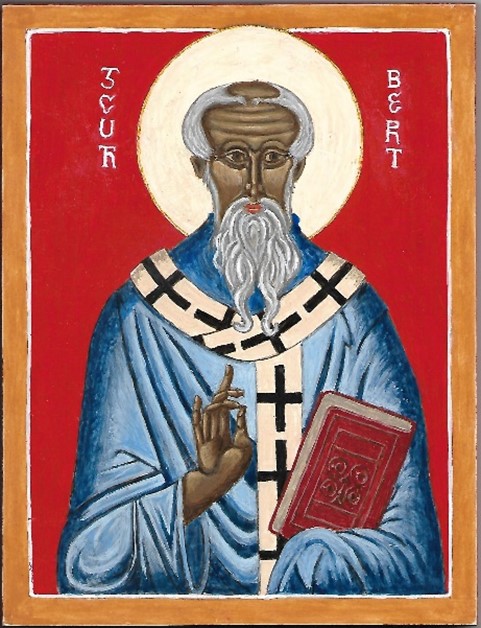
St Cuthbert, 634-687, is portrayed as a bishop, blessing with his right hand, a normal gesture for a saint. In his left he holds the book of the gospels with which he was buried, and is now in the British Museum. He is often portrayed (wrongly) wearing a mitre, an invention of the later mediaeval period. He died on Inner Farne, by then a hermit in 685. He has ever since been hailed as the Saint of the North
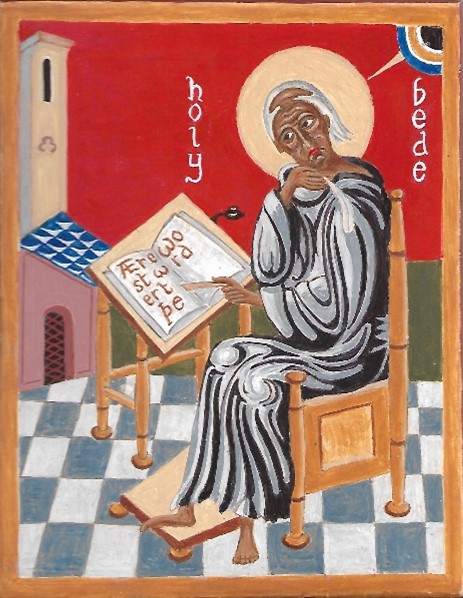
Venerable Bede, 673-735, first translator of the gospels into English. He is portrayed deep in thought as writes the opening line of St John’s Gospel in (Old) English, having already written The Ecclesiastical History of the English People, and many other theological and scientific works. The composition is partly inspired by Fenwick Lawson’s sculpture of Bede. He became renowned as a scholar throughout mediaeval Europe
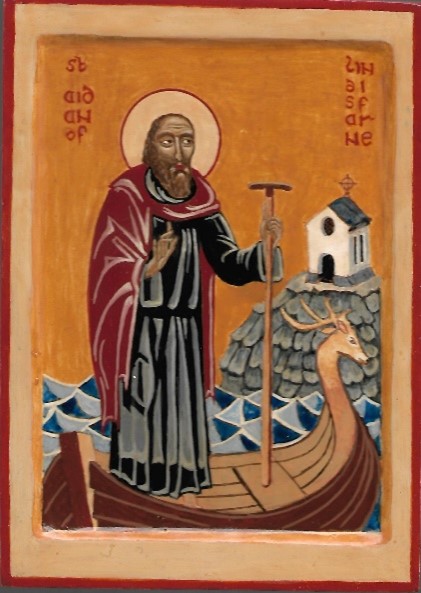
St Aidan of Lindisfarne, called by King Oswald to evangelise from Iona his kingdom and set up his monastery at Lindisfarne, shown in the icon, where later the Lindisfarne Gospels would be created. In the icon the tau-cross doubles as a mast for the boat. The stag’s head prow recalls Aidan’s request to build a monastery between the antlers of a stag he could see from Bamburgh, the royal Palace. His gaze fell on Lindisfarne. The boat itself recalls the Ark, a perpetual symbol of salvation. He was known for his humility and concern for the poor. He died in Bamburgh church in 651
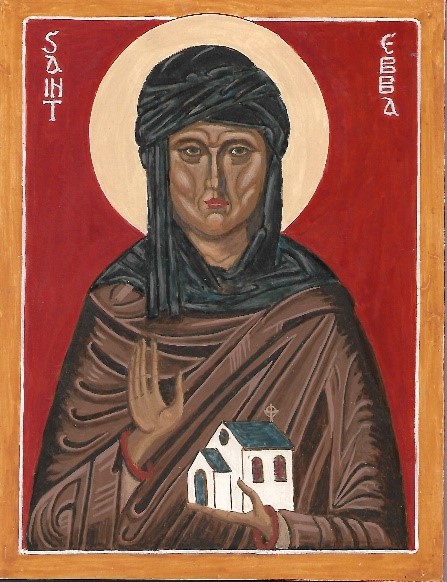
St Ebba the Elder, sister to St Oswald, the remains of whose chapel can still be seen at Ebb’s Neuk, Beadnell. She is portrayed holding the double monastery of Coldingham, now in Scotland, but then in the Kingdom of Northumbria, of which she later became abbess. She is remembered in the dedication of Beadnell parish church. She is also associated with Ebchester and St. Abbs Head
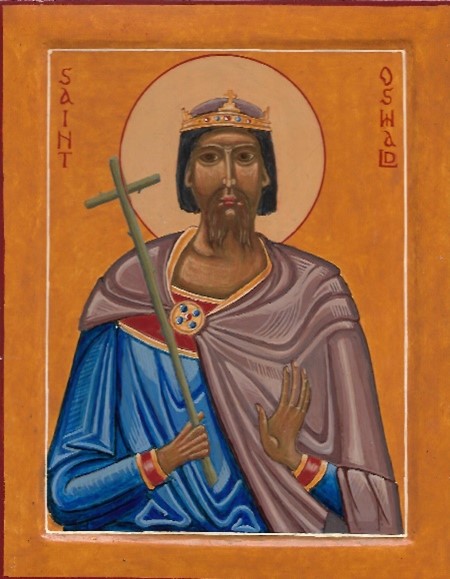
St Oswald, b.604, returning from exile in 634, and whose victory over invaders at Heavenfield near Hexham established him as King of Northumbria, ushered in the ‘Golden Age’ of Northumbria. Through him, St Aidan was called from Iona to evangelise his kingdom. In this he accompanied Aidan translating his words into English. Oswald died in battle fighting the heathens at Oswestry, Shropshire in 642, where there is a commemorative well. The icon shows him holding a cross cut from a still leafed tree, as Bede recounts, before which he and his army prayed before Heavenfield. It also shows the holder to be a martyr
 northodoxy.com